
Restoring Alignment at a $25M GovCon Firm
Restoring Alignment at a $25M GovCon Firm
![[HERO] Restoring Alignment at a $25M GovCon Firm](https://cdn.marblism.com/azUNqfAXGWr.webp "[HERO] Restoring Alignment at a $25M GovCon Firm")
The CEO didn't expect the Monday call. Three missed deliverables. Two contract managers working opposite priorities. One frustrated government contracting officer asking why the left hand doesn't know what the right is doing.
Sound familiar?
This wasn't a startup finding its footing. This was a $25M government contractor with seventeen years of performance history. They had the talent. They had the contracts. They had the capacity.
What they didn't have: structural clarity.
The Growth Trap
Here's what happens when a GovCon firm scales from $10M to $25M.
Headcount doubles. Contracts multiply. Compliance requirements compound. Decision pathways that worked at smaller scale fracture under the weight of complexity.
The executive team starts holding more meetings. They debate strategy. They refine messaging. They reorganize territories.
None of it works.
Because they're solving the wrong problem.

The Misdiagnosis
Most executives facing operational strain diagnose it as a strategic problem.
"We need clearer priorities."
"We need better communication."
"We need refined objectives."
They're wrong.
The problem is structural.
When decision architecture is unclear, growth doesn't scale: it fragments. Every new hire, every new contract, every new compliance requirement adds another node to an already tangled system.
Priorities don't just conflict. They collide. Execution doesn't just slow. It stops. Leadership doesn't lead. It firefights.
Research from the Project Management Institute shows that organizations with structured PMOs see 38% fewer projects fail and 33% fewer budget overruns. Yet most mid-sized GovCon firms treat project structure as optional: until they can't.
How This Plays Out in Federal Contracting
Government contracting magnifies structural weakness.
You're not just managing projects. You're managing:
Federal Acquisition Regulation (FAR) compliance
Cost Accounting Standards (CAS) requirements
Defense Federal Acquisition Regulation Supplement (DFARS) obligations
Earned value management reporting
Multiple contracting officers across different agencies
Subcontractor coordination
Security clearance protocols
Each requirement creates decision points. Each decision point requires authority. Each authority requires clarity.
When that clarity doesn't exist, everything stalls.
The proposal team submits a win theme that operations can't deliver. The finance team flags a compliance issue that the program manager didn't know existed. The BD team promises a capability level that requires approvals from three people who don't agree on priorities.

Non-compliance doesn't just risk penalties. It risks debarment. According to federal procurement data, contractors face an average of $2.3M in audit findings annually when compliance culture isn't embedded organization-wide.
That's not a training problem. That's a structure problem.
The Structural Breakdown
Here's what structural failure looks like at $25M:
Decision bottlenecks. Every approval requires the founder. The founder becomes the constraint.
Information silos. Operations knows something finance doesn't. Finance knows something BD doesn't. Nobody has the full picture.
Authority confusion. Three people believe they own the same decision. Or nobody believes they own it.
Reactive leadership. Executives spend 60% of their time managing crises instead of leading growth.
Talent drain. High performers leave because they can't get clarity fast enough to do their jobs.
The cost isn't just operational. It's strategic. When your structure is broken, your best people work around it instead of through it. They create shadow processes. They hoard information. They protect their turf.
Not because they're difficult. Because the system forces them to.
What Structure Actually Means
Structure is not hierarchy.
Structure is clarity.
Clarity about:
Who decides what
Who needs to know when
What information flows where
Which authorities live with whom
How escalations move
When decision architecture is clear, talent gets liberated. Leaders can lead instead of micromanage. Execution accelerates instead of fragments.
The difference between a $25M firm that feels chaotic and one that feels controlled isn't strategy. It's whether people know where decisions live.

The Blue Stallion Approach
We stabilize the structure that enables execution.
Not through reorganizations. Not through new roles. Through decision mapping.
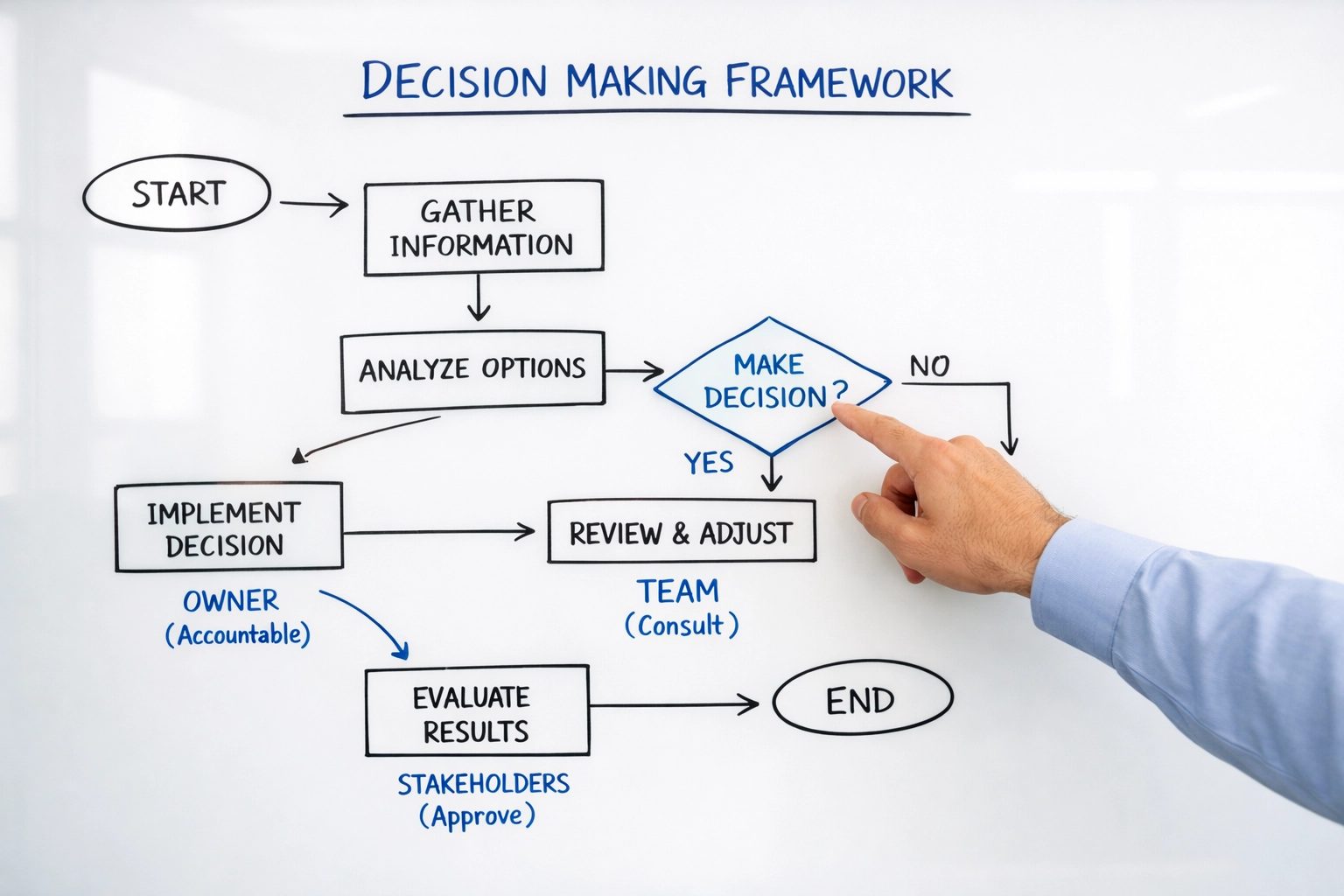
Step one: Map the current state. Where do decisions actually get made today? Not where the org chart says they should be made: where they actually happen. What information is required? Who holds it? Where are the bottlenecks?
Step two: Identify the breaks. Where does authority overlap? Where are gaps? Which decisions require three approvals when one would suffice? Which require no approval when they should?
Step three: Design clarity. Rebuild decision pathways so authority flows with minimal friction. Embed accountability at each node. Make information visible to those who need it.
Step four: Embed compliance structure. In GovCon, compliance can't sit in one department. It has to live in the decision architecture. Every contract decision, every project milestone, every financial commitment needs built-in compliance checkpoints: not as bureaucracy, but as embedded protocol.
Effective structure doesn't slow things down. It speeds them up.
Because when people know who decides and what they need, they stop waiting. They stop duplicating. They stop working around the system.
They work through it.
Why This Matters Now
The federal marketplace is consolidating. Smaller contracts are disappearing. Larger contracts demand more sophisticated delivery.
The firms that scale past $25M aren't the ones with the best strategic plans. They're the ones with the clearest decision architecture.
When a contracting officer asks why your teams aren't aligned, "we're working on communication" isn't an answer. When an audit identifies compliance gaps across three programs, "we're refining our processes" doesn't cut it.
You need structural clarity.
Not eventually. Now.
The Result
When structure gets stabilized, several things happen fast:
Decisions accelerate. Execution aligns. Crises decrease. Leaders stop firefighting and start leading. High performers stop leaving because they can finally do their jobs without fighting the system.
Revenue doesn't just grow. Margin improves. Because waste drops. Rework declines. Opportunity cost disappears.
That's the difference between a $25M firm grinding against itself and a $25M firm positioned to scale to $50M.
Structure isn't the exciting work. But it's the work that makes everything else possible.
Your Move
If your executive team is debating strategy while your operations are fragmenting, you're solving the wrong problem.
The question isn't "What's our vision?" The question is "Where do decisions break?"
Map the architecture. Find the bottlenecks. Restore the flow.
Ready to stabilize your structure? Visit Blue Stallion Solutions to explore how decision architecture mapping can restore alignment in your organization.
Blue Stallion Solutions | www.bluestallionsolutions.com